Kuwait Decree 10/2026 Deadline: When Must Online Sellers Comply?
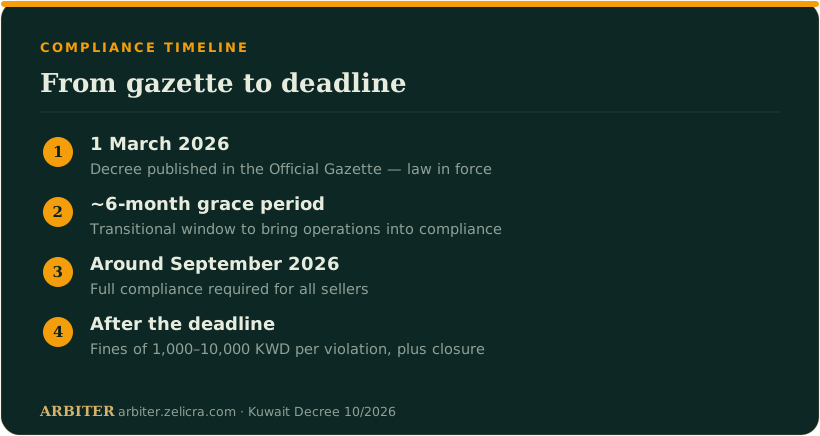
Kuwait's Decree 10/2026 was published in the Official Gazette on 1 March 2026 and is already in force. Sellers were given a transitional grace period of roughly six months, so full compliance is expected by around September 2026. After the grace period, the Ministry of Commerce and Industry (MOCI) can impose fines of 1,000–10,000 KWD per violation, order store closure, and — for serious breaches — pursue imprisonment of up to one year.
If you sell online to customers in Kuwait, the single most important date to understand is your compliance deadline. Kuwait's Digital Commerce Law — formally Amiri Decree-Law No. 10 of 2026 — is not a future proposal. It is enacted law, and the clock is already running. This guide explains exactly when the law took effect, how long the grace period lasts, what happens if you miss the deadline, and why waiting until the last week is the most expensive choice you can make.
Is Decree 10/2026 already in force?
Yes. The State of Kuwait published Decree No. 10/2026, titled "Decree-Law Regarding Regulating Digital Commerce," in the Official Gazette on 1 March 2026. From that date, the law is legally in force. What sellers were given is not a delay in the law itself, but a transitional (grace) period in which to bring their operations into compliance before enforcement begins in earnest.
When exactly is the compliance deadline?
The transitional window runs for approximately six months from publication, which places the practical compliance deadline at around September 2026. MOCI is expected to issue detailed implementing regulations during this window — covering procedural specifics such as registration forms, data-breach notification timelines, and acceptable address formats — but the core obligations themselves are already fixed by the Decree text and are not expected to change.
Compliance Timeline at a Glance
- 1 March 2026: Decree 10/2026 published in the Official Gazette. The law is in force.
- March–September 2026: Six-month transitional period. Prepare and implement all 18 obligations.
- ~September 2026: End of the grace period. Full compliance expected; enforcement intensifies.
- Ongoing: MOCI conducts inspections and issues supplementary guidelines.
What happens if you miss the deadline?
Once the grace period ends, non-compliance is enforceable. The penalty regime is one of the most consequential in the Gulf:
Penalties for Missing the Deadline
- Fines of 1,000–10,000 KWD per violation. Each obligation you breach is treated as a separate violation, so exposure stacks quickly.
- Imprisonment of up to one year for serious or willful breaches, particularly those involving fraud or systematic consumer harm.
- Temporary suspension or permanent closure of the digital storefront, including removal from the Digital Commerce Register.
- Doubled penalties for repeat offenders, plus unannounced MOCI inspections that can examine your records, communications, and advertising at any time.
For a full breakdown of how fines are calculated and stacked, see our detailed guide to Decree 10/2026 penalties.
See Where You Stand — Free, No Signup
Check your online business against all 18 requirements of Decree 10/2026 in about five minutes.
Run the Free Checklist →Why you should not wait until September
The grace period is a preparation window, not a postponement — and several obligations take real time to implement. Treating September as a hard "start" date underestimates the lead time involved:
- MOCI registration is the foundational step and can involve processing time. See our MOCI registration guide.
- Arabic invoicing with Hijri dates often requires changes to off-the-shelf checkout and order systems that were never built for it. See the Arabic invoicing guide.
- A compliant 14-day return policy must be documented, displayed before checkout, and wired into your refund flow. See the return policy guide.
- Five-year record retention means moving from informal WhatsApp order history to structured, audit-ready records.
A realistic 60-day compliance plan
- Weeks 1–2: Audit against all 18 requirements using the free checklist, and start MOCI registration.
- Weeks 3–5: Update your storefront with business identity in Arabic, transparent KWD pricing, and a compliant return policy.
- Weeks 6–7: Implement Arabic invoicing, terms & conditions, and a privacy policy; set up a complaint-handling process.
- Week 8: Review advertising and influencer partnerships for disclosure, and confirm records are being retained.
Sellers who begin now will have time to implement changes methodically. Those who wait until the final weeks face a far riskier scramble — and any gaps that remain after the deadline are enforceable violations. For the complete obligation-by-obligation breakdown, read the Complete Guide to Kuwait Decree 10/2026.
Frequently Asked Questions
When was Kuwait Decree 10/2026 published?
Decree-Law No. 10 of 2026 was published in Kuwait's Official Gazette on 1 March 2026 and has been in force since that date.
Is there a grace period for Decree 10/2026?
Yes. Sellers were given a transitional period of roughly six months from publication, placing the practical compliance deadline at around September 2026.
What happens if I miss the compliance deadline?
After the grace period, MOCI can impose fines of 1,000–10,000 KWD per violation, order suspension or closure of the store, and pursue imprisonment of up to one year for serious or willful breaches.
Does the deadline apply to Instagram and WhatsApp sellers?
Yes. Decree 10/2026 applies to all digital commerce directed at consumers in Kuwait, including Instagram, WhatsApp, and other social-commerce sellers, with no exemption for small or individual sellers.