Kuwait Online Payment Rules: KNET, CBK & the No-Surcharge Rule
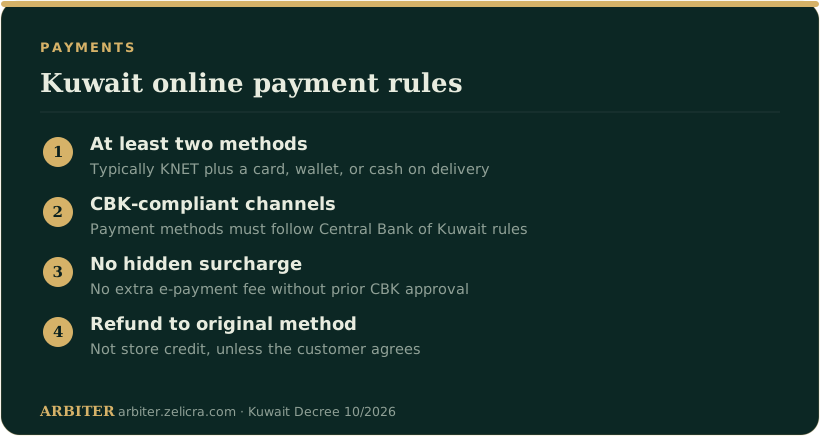
Under Decree 10/2026, Kuwait online sellers must offer at least two payment methods (typically KNET plus one more), use payment methods that comply with Central Bank of Kuwait (CBK) instructions, and must not add extra e-payment fees to customers without prior CBK approval. Refunds must go back to the original payment method.
Payments sit at the centre of Kuwait's Digital Commerce Law because they are where consumer trust is most often broken — through hidden fees, surprise surcharges, or refunds paid in store credit. Decree 10/2026 addresses each of these directly. This guide explains the payment obligations every Kuwait online seller must meet, and the mistakes that most commonly trigger a violation.
Offer at least two payment methods
The Decree requires sellers to give consumers genuine choice at checkout by offering a minimum of two payment options. In the Kuwaiti market, the practical expectation is KNET — the national debit network — plus at least one additional method such as a credit card, a digital wallet, or cash on delivery. Relying on a single informal payment channel (for example, bank transfers arranged over WhatsApp) does not meet the standard.
Use CBK-compliant payment methods
Payment methods must comply with Central Bank of Kuwait instructions and the state's banking regulations. In practice, this means routing card and electronic payments through licensed, regulated channels rather than unregulated workarounds. The same principle extends to influencer payments, which must use reliable, AML-compliant methods consistent with CBK rules — covered in the influencer compliance guide.
The no-surcharge rule
One of the most consumer-facing provisions is the restriction on surcharges. Sellers are prohibited from imposing additional electronic-payment fees on customers without prior approval from the Central Bank of Kuwait. The common practice of adding a "card fee" or "KNET fee" at checkout to pass processing costs to the buyer is not permitted by default. Prices must also be transparent and fully inclusive — hidden charges revealed only at checkout are separately prohibited under the Decree's pricing rules.
Common Payment Violations to Avoid
- Adding a card or e-payment surcharge without CBK approval.
- Offering only one payment method.
- Revealing fees only at the final checkout step.
- Refunding to store credit instead of the original payment method.
Refunds must return to the original method
When a return is accepted under the mandatory 14-day return policy, the refund must be issued to the same payment method the customer used — not as store credit or a voucher, unless the customer explicitly agrees to an alternative. This closes a frequent loophole where sellers try to retain revenue by refunding only in credit.
Check Your Payment & Pricing Compliance
The free 18-point checker reviews payments, pricing transparency, and refunds together — five minutes, no signup.
Run the Free Checklist →A quick payment-compliance checklist
- Offer at least two payment methods, including KNET.
- Route electronic payments through CBK-compliant, licensed channels.
- Remove any customer-facing e-payment surcharge unless you have CBK approval.
- Display fully inclusive KWD prices with no fees hidden until checkout.
- Configure refunds to return to the original payment method.
Payments, pricing, and returns are tightly linked in Decree 10/2026, and a gap in one often signals a gap in the others. For the full set of obligations, read the Complete Guide to Kuwait Decree 10/2026.
Frequently Asked Questions
Can I charge customers a card or KNET fee in Kuwait?
Not by default. Decree 10/2026 prohibits adding extra electronic-payment fees to customers without prior approval from the Central Bank of Kuwait.
Do I need to offer KNET?
Sellers must offer at least two payment methods, and in the Kuwaiti market this practically means KNET plus at least one other option such as a card, wallet, or cash on delivery.
What does CBK-compliant payment mean?
Payments must run through channels that comply with Central Bank of Kuwait instructions and state banking regulations, rather than unregulated workarounds.
How must refunds be paid?
Refunds for accepted returns must go back to the original payment method the customer used, not store credit or a voucher, unless the customer explicitly agrees otherwise.