Complaint Handling Rules for Kuwait Online Sellers
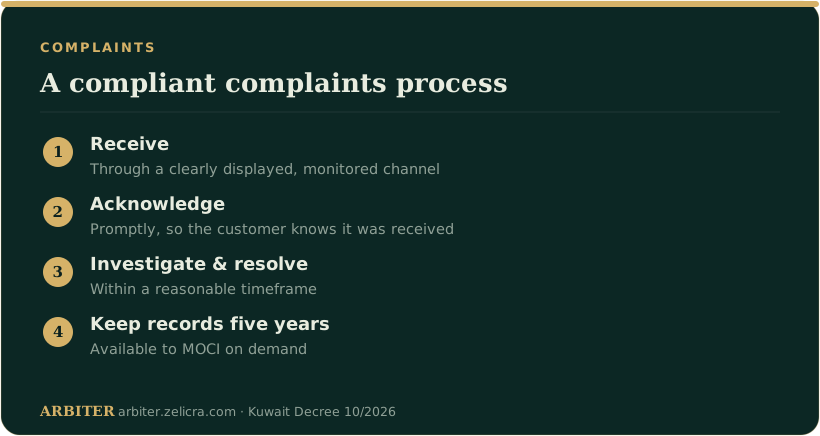
Decree 10/2026 requires Kuwait online sellers to provide an accessible complaints channel and follow a documented process to receive, acknowledge, investigate, and resolve consumer complaints. All complaints and their resolutions must be recorded and kept for five years, and made available to MOCI on request. An unresponsive seller is itself in breach.
Complaint handling is one of the most frequently overlooked obligations in Kuwait's Digital Commerce Law — and one of the easiest for a regulator to check. If a customer cannot reach you, or their complaint disappears into an unmonitored inbox, you are exposed. This guide explains what a compliant complaint-handling process looks like under Decree 10/2026.
Provide an accessible complaints channel
Every storefront — website, Instagram, or marketplace listing — must offer at least one clearly displayed, responsive channel through which consumers can raise inquiries and complaints. It must be easy to find (not buried) and it must actually be monitored. A contact method that no one answers does not satisfy the requirement.
Follow a documented process
Beyond simply having a channel, you need a repeatable process. In practice that means:
- Receive the complaint through a defined intake point.
- Acknowledge it promptly so the customer knows it was received.
- Investigate the issue and communicate with the customer.
- Resolve it within a reasonable timeframe, applying the customer's rights (such as the 14-day return or a refund to the original payment method).
Keep records for five years
Complaints and their resolutions must be logged and retained for five years, alongside your other transaction records, and produced on demand during a MOCI inspection. This ties complaint handling directly to the Decree's record-retention rule. A verbal resolution with no record is difficult to defend if the same customer later escalates to the regulator.
Is Your Complaints Process Compliant?
The free 18-point checker flags complaint-handling gaps with the rest of your obligations — five minutes, no signup.
Run the Free Checklist →Why this matters more than it seems
Consumer complaints were a driving reason Kuwait enacted the law — grievances about refused returns and unreachable sellers were widespread. Regulators therefore treat responsiveness as a signal of overall compliance. A documented, well-run complaints process not only meets the obligation; it reduces the chance a dispute becomes a MOCI matter in the first place.
Practical steps
- Publish a monitored complaints channel on every storefront.
- Write a short internal procedure for intake, acknowledgement, investigation, and resolution.
- Log every complaint and its outcome in your records system.
- Review recurring complaints to fix root causes (delivery times, product accuracy, returns).
Complaint handling is one of the 18 obligations that together define full compliance. See them all in the Complete Guide to Kuwait Decree 10/2026.
Frequently Asked Questions
Does Decree 10/2026 require a complaints process?
Yes. Sellers must provide an accessible, monitored complaints channel and follow a documented process to receive, acknowledge, investigate, and resolve complaints.
How long must complaint records be kept?
Complaints and their resolutions must be logged and retained for at least five years, alongside other transaction records, and produced on demand during a MOCI inspection.
Is an unresponsive seller in breach?
Yes. Providing a channel that no one monitors, or failing to handle complaints, is itself a violation of the Decree's complaint-handling obligation.
Where does complaint handling fit among the 18 requirements?
It is one of the 18 obligations and connects to returns, refunds, and record retention, so a weak complaints process often signals other gaps.