Kuwait's 5-Year Data Retention Rule for Online Sellers
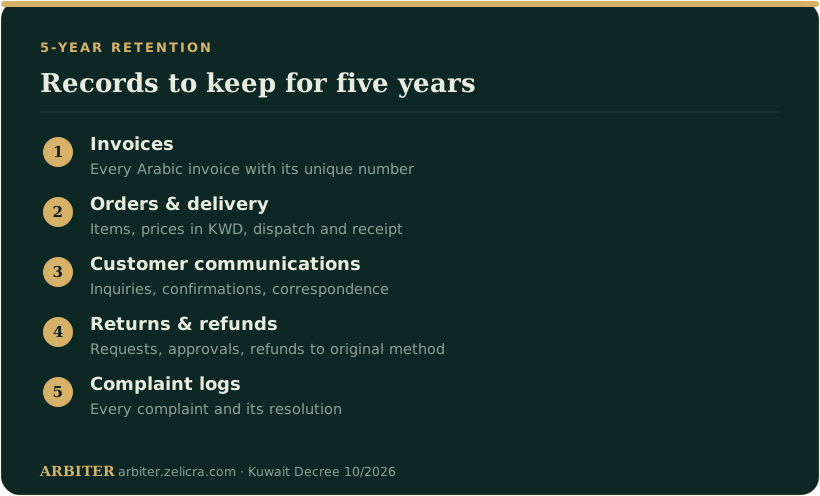
Decree 10/2026 requires Kuwait online sellers to keep all transaction records for a minimum of five years — including invoices, order details, customer communications, delivery confirmations, returns, refunds, and complaint logs. These records must be audit-ready and produced on demand during a MOCI inspection. Records must also be stored securely under the Decree's data-protection obligations.
One of the quieter but most operationally demanding provisions of Kuwait's Digital Commerce Law is its record-keeping mandate. For many small and social-commerce sellers, order history lives in scattered WhatsApp chats and inboxes. Decree 10/2026 turns record-keeping from a loose habit into a legal obligation with a defined retention period and real penalties for failure. Here is exactly what you must keep, for how long, and how to store it defensibly.
How long must records be kept?
The Decree sets a retention floor of five years, measured from the date of each transaction. That means a sale made today must remain retrievable — with all its supporting documentation — for five full years. There is no small-seller carve-out: the obligation applies whether you run a large e-commerce operation or sell through a personal Instagram account.
Which records must you retain?
The requirement is comprehensive. At minimum, sellers should retain:
- Invoices — the Arabic (or bilingual) invoice issued for every transaction, with its unique number. See the Arabic invoicing guide.
- Order details — items, quantities, prices in KWD, dates, and buyer information.
- Customer communications — inquiries, confirmations, and any correspondence relating to an order.
- Delivery confirmations — proof of dispatch and receipt, which also anchors the 14-day return clock.
- Returns and refunds — return requests, approvals, and refund records to the original payment method.
- Complaint logs — every complaint, its handling, and its resolution.
- Influencer engagements — contracts and payment records, which carry their own five-year retention. See the influencer compliance guide.
Why it matters: audit-ready, on demand
Because MOCI inspectors can request compliance documentation without prior notice, retention is not just about storage — it is about being able to produce complete, organised records at any time. A seller who technically "has" records buried across chat apps but cannot retrieve them coherently during an inspection is exposed to the same enforcement as one who kept nothing. Structured, searchable records are the practical standard.
Is Your Record-Keeping Compliant?
The free 18-point checker flags retention gaps alongside the other 17 obligations — five minutes, no signup.
Run the Free Checklist →Storing records securely
Retention overlaps with the Decree's data-protection and cybersecurity obligations. The same customer data you must keep for five years must also be protected against unauthorised access, loss, or disclosure, with appropriate technical and organisational safeguards. In practice, that points toward a structured system — not a personal phone — with access controls and reliable backups.
Practical steps for sellers
- Move off informal channels. Capture each order into a structured record (a proper order system or, at minimum, a consistent spreadsheet and invoice archive).
- Standardise your invoice archive so every transaction's Arabic invoice is stored with its unique number.
- Log returns and complaints from day one — these are explicitly named and frequently the hardest to reconstruct later.
- Set a five-year retention rule and protect the store with access controls and backups.
Record-keeping is foundational to almost every other obligation — returns, complaints, invoicing, and influencer compliance all depend on it. For the full obligation map, see the Complete Guide to Kuwait Decree 10/2026.
Frequently Asked Questions
How long must Kuwait online sellers keep records?
A minimum of five years from the date of each transaction, under Decree 10/2026.
Which records must be retained?
Invoices, order details, customer communications, delivery confirmations, returns and refunds, complaint logs, and influencer contracts and payments — all kept audit-ready.
Where should I store these records?
In a structured, secure system with access controls and backups. The same data must be protected under the Decree's data-protection obligations, not left in personal chat apps.
Does the retention rule apply to Instagram and WhatsApp sales?
Yes. There is no small-seller exemption, so social-commerce and messaging-app sellers must retain the same records for five years and produce them on demand.